
E-mail and delete the Outlook object error:
When you delete an e-mail or other items in Outlook, clicking on the button "Del" button, and then will be transferred to the Trash folder. You can simply restore in the Trash folder, you want to find e-mail messages, and returns to its original location or any other normal folder.
However, if you delete the paragraph with "Ctrl - Del", or remove this item from the "basket" folder, then delete the item permanently from Outlook. This is the only way to restore it is to use our product Advanced Outlook Repair can solve this problem, like the wind, namely:
1. Select the Outlook PST file, delete a number of projects is a source to restore files PST.
2. Conclude fixed PST file name if necessary.
3. Repair Outlook PST source. Advanced Outlook Repair will scan and remove deleted items.
4. In the process of repair, you can use Outlook, to open the file PST, and still find all deleted items to restore the objects to delete forever. For example, if you use "Ctrl - Del" to delete an e-mail inbox, then Advanced Outlook Repair will be restored on the Inbox to a folder in the recovery process. If you are using the "Delete" to delete this message from your Inbox, and then removed from the basket, and then restore, will return to a "basket" folder.
Note:
1. If you can not find a place in the draft, they will be deleted permanently, you can try to find their own way, are as follows:
1.1, to find their "Recovered_Groupxxx file. Deleted items can be viewed as objects found that the restoration and creation of a folder named" Recovered_Groupxxx "set in the file PST.
1.2 If you want to know more about the nature of the project, such as electronic mail, provided a number of key words in the body of an email message, and so on, then you can use these attributes as search criteria, Outlook, and use search to find desired point on all fixed assets PST. In some cases, deleted items can be restored, and in any other file or folder name. Use the search function in Outlook, you can find them easily.
You may notice, to eliminate duplication Recovered_Groupxxx file. Please just ignore them. When Microsoft Outlook, to delete a project, it will make copies of implied. Advanced Outlook Repair is so powerful that it can obtain a copy of these implicit and treat them as found objects, which are the restoration and creation of a folder named "Recovered_Groupxxx" set in the file PST.
Showing posts with label Computer Support. Show all posts
Showing posts with label Computer Support. Show all posts
Friday, July 17, 2009
Tuesday, July 14, 2009
How to get the Calendar or Task Reminders - Outlook 2000
1 comments
Labels: Computer Help, Computer Repair, Computer Support, dell support, hp printer repair, increase internet speed, Microsoft office, Microsoft Outlook, Microsoft Support
Labels: Computer Help, Computer Repair, Computer Support, dell support, hp printer repair, increase internet speed, Microsoft office, Microsoft Outlook, Microsoft Support

Symptoms: - May your Outlook calendar or task reminders do not appear as scheduled. In addition, in May, you will receive the following message when you click Save and close the new appointment, pay attention to:
Paul said that the investigation in May, not because the issue is not on your calendar or task folder. All this is true?
Reasons: - There are four reasons for this behavior:
* Outlook does not work. Microsoft Schedule +, which is a separate file to handle reminders, the main control program like Outlook. If Outlook is not running, it is not known.
* To remember the calendar or task will not be in your folder. God reminds the lead in the calendar or task folder. The presence of the main folder in your mail. When you create an e - mail, you specify your mail or in personal folders (. PST) in the folder "Incoming e-mail points.
For example, if you get mail in personal folders (. PST) file Inbox and create an appointment in your mailbox, calendar reminder to remind people not happen. If you create the same reminder in your calendar of personal records, it appears that, in a reminder that when the time comes.
* Email service is set to "None" (without the quotes). You must specify the default location for the operational services to cope.
* Note the folder that contains the damaged or corrupted reminder items.
Resolution: - use one of the following methods to solve this problem:
* If Outlook is not running, start Outlook, Outlook is working, and constantly keep in mind is obtained.
* When you create reminders, verify that they are stored in the calendar, or tasks.
* From Outlook, click Start, Run, type Outlook / CleanReminders, and then click OK.
Paul said that the investigation in May, not because the issue is not on your calendar or task folder. All this is true?
Reasons: - There are four reasons for this behavior:
* Outlook does not work. Microsoft Schedule +, which is a separate file to handle reminders, the main control program like Outlook. If Outlook is not running, it is not known.
* To remember the calendar or task will not be in your folder. God reminds the lead in the calendar or task folder. The presence of the main folder in your mail. When you create an e - mail, you specify your mail or in personal folders (. PST) in the folder "Incoming e-mail points.
For example, if you get mail in personal folders (. PST) file Inbox and create an appointment in your mailbox, calendar reminder to remind people not happen. If you create the same reminder in your calendar of personal records, it appears that, in a reminder that when the time comes.
* Email service is set to "None" (without the quotes). You must specify the default location for the operational services to cope.
* Note the folder that contains the damaged or corrupted reminder items.
Resolution: - use one of the following methods to solve this problem:
* If Outlook is not running, start Outlook, Outlook is working, and constantly keep in mind is obtained.
* When you create reminders, verify that they are stored in the calendar, or tasks.
* From Outlook, click Start, Run, type Outlook / CleanReminders, and then click OK.
Thursday, July 9, 2009
Where Does Outlook Store All History Data ? ?
1 comments
Labels: Computer Help, Computer Repair, Computer Support, dell support, hp printer repair, increase internet speed, Microsoft office, Microsoft Outlook, Microsoft Support
Labels: Computer Help, Computer Repair, Computer Support, dell support, hp printer repair, increase internet speed, Microsoft office, Microsoft Outlook, Microsoft Support
Will all of your Outlook data (e-mail, contacts, calendar, etc.) in the ominous "Personal Folders" (. Pst) file. They are proprietary and complex, it is a good idea, and then return to their now. First, you need to find the location to make your Outlook. pst files, but.
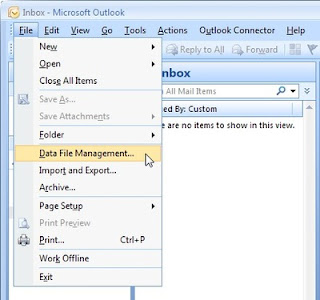
* Select File Data File Management ... from the menu in Outlook.
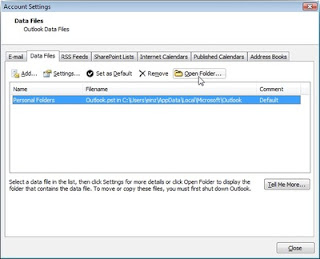
* Highlight your main data file (usually called Personal Folders).
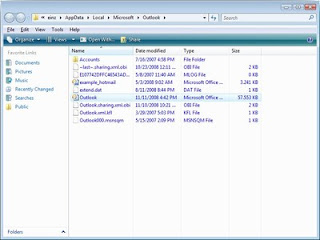
* Click to open the folder ....
To determine the folder and an earlier version of Outlook 2002 to save your data:
* Right-mouse click the Outlook Today, whether in the Outlook bar or folder list.
* Select Properties from the pop-up menu.
* Select Advanced ....
* Please note the path listed under Path:.
* Select the path does not include the file name (usually this will be "outlook.pst") with your mouse.
* Press Ctrl - C to copy the path.
o If, for example, the path listed under Path: is the "C: \ The Documents and Settings \ email.guide \ Application Data \ Microsoft \'s Outlook \ outlook.pst", you can select and copy the "C: \ of the Documents and Settings \ email.guide \ Application Data \ Microsoft \ Outlook in \. "
* Now select Run ... from the Start menu.
* Press Ctrl - V to paste the path
Press the Enter key to open your Outlook data folder in Windows Explorer.
* Select File Data File Management ... from the menu in Outlook.

* Highlight your main data file (usually called Personal Folders).

* Click to open the folder ....

To determine the folder and an earlier version of Outlook 2002 to save your data:
* Right-mouse click the Outlook Today, whether in the Outlook bar or folder list.
* Select Properties from the pop-up menu.
* Select Advanced ....
* Please note the path listed under Path:.
* Select the path does not include the file name (usually this will be "outlook.pst") with your mouse.
* Press Ctrl - C to copy the path.
o If, for example, the path listed under Path: is the "C: \ The Documents and Settings \ email.guide \ Application Data \ Microsoft \'s Outlook \ outlook.pst", you can select and copy the "C: \ of the Documents and Settings \ email.guide \ Application Data \ Microsoft \ Outlook in \. "
* Now select Run ... from the Start menu.
* Press Ctrl - V to paste the path
Press the Enter key to open your Outlook data folder in Windows Explorer.
Monday, July 6, 2009
Dealing with .pst Files
2
comments
Labels: Computer Help, Computer Repair, Computer Support, dell support, hp printer repair, increase internet speed, Microsoft office, Microsoft Outlook, Microsoft Support
Labels: Computer Help, Computer Repair, Computer Support, dell support, hp printer repair, increase internet speed, Microsoft office, Microsoft Outlook, Microsoft Support
For Microsoft Office Outlook 2003 can support a greater personal folders (. Pst) files than earlier versions - up to 33TB. In view of the possibility of archive or export. pst files may be large enough to increase the exclusion of other data the user's hard drive, you may want to look at again. pst file to use in your organization. Outlook 2003, you can use Group Policy to control the size of the old and new. pst file. Even if you are not planning to move to Outlook 2003 any time soon, know how to use Outlook. pst file, and you can disable the use of an earlier version can come in handy.
Use Outlook. pst file you are more likely than the achievement. The most familiar use is an independent user. pst file, not the Exchange mailbox as the default information store. Users can usually create more. pst file to open Outlook's automatic archiving function, which the old items. regular schedule pst file, or through the use of the file, import and export data export orders. pst file. Outlook also automatically creates a. pst file, if the user adds an IMAP4 or Hotmail account to his or her e-mail profile; Outlook use this. pst file to store the local cache of the IMAP or Hotmail e-mail account. Finally, Outlook 2003 to create a new one. pst file, if a user views a Windows SharePoint Services (WSS) events or contacts list, and click the "Link to Outlook" link; this. pst file contains the local copy of SharePoint links list.
Provide some control over it. pst file use, Outlook 98 and later support DisablePST registry values. This DWORD value is in the HKEY_LOCAL_MACHINE \ Software \ Microsoft \ Office \ 11.0 \ Outlook registry subkey in in Outlook 2003; change "11.0" to "10.0" in the Outlook 2002, "9.0" in the Outlook 2000, or "8.0 "The Outlook 98. The DisablePST value does not exist by default, so you need to buy, if you want to disable. pst file. Allowable value is 1 (disabled) and 0 (enabled, default).
DisablePST initial use of an earlier version of Outlook 2002 in, Outlook 2000, the Outlook 98 and in order to prevent users from archiving and export or import. pst file. DisablePST 1 set of these versions of these functions shut down and disable the creation of new. pst file from the file, the new menu. User account configuration in the enterprise / working group model, however, still be able to add new or existing. pst file to their email profile (through the file, Data File Management dialog box or in Outlook 2002 the tools, services dialog box in Outlook 2000 or Outlook 98), therefore some of the Ad Hoc Committee. pst file use is still possible in these versions.
Source :- http://windowsitpro.com/article/articleid/40961/dealing-with-pst-files.html
Use Outlook. pst file you are more likely than the achievement. The most familiar use is an independent user. pst file, not the Exchange mailbox as the default information store. Users can usually create more. pst file to open Outlook's automatic archiving function, which the old items. regular schedule pst file, or through the use of the file, import and export data export orders. pst file. Outlook also automatically creates a. pst file, if the user adds an IMAP4 or Hotmail account to his or her e-mail profile; Outlook use this. pst file to store the local cache of the IMAP or Hotmail e-mail account. Finally, Outlook 2003 to create a new one. pst file, if a user views a Windows SharePoint Services (WSS) events or contacts list, and click the "Link to Outlook" link; this. pst file contains the local copy of SharePoint links list.
Provide some control over it. pst file use, Outlook 98 and later support DisablePST registry values. This DWORD value is in the HKEY_LOCAL_MACHINE \ Software \ Microsoft \ Office \ 11.0 \ Outlook registry subkey in in Outlook 2003; change "11.0" to "10.0" in the Outlook 2002, "9.0" in the Outlook 2000, or "8.0 "The Outlook 98. The DisablePST value does not exist by default, so you need to buy, if you want to disable. pst file. Allowable value is 1 (disabled) and 0 (enabled, default).
DisablePST initial use of an earlier version of Outlook 2002 in, Outlook 2000, the Outlook 98 and in order to prevent users from archiving and export or import. pst file. DisablePST 1 set of these versions of these functions shut down and disable the creation of new. pst file from the file, the new menu. User account configuration in the enterprise / working group model, however, still be able to add new or existing. pst file to their email profile (through the file, Data File Management dialog box or in Outlook 2002 the tools, services dialog box in Outlook 2000 or Outlook 98), therefore some of the Ad Hoc Committee. pst file use is still possible in these versions.
Source :- http://windowsitpro.com/article/articleid/40961/dealing-with-pst-files.html
Wednesday, July 1, 2009
Display a map for an Outlook Contact's U.S. address
0
comments
Labels: Computer Help, Computer Repair, Computer Support, dell support, hp printer repair, increase internet speed, Microsoft office, Microsoft Outlook, Microsoft Support
Labels: Computer Help, Computer Repair, Computer Support, dell support, hp printer repair, increase internet speed, Microsoft office, Microsoft Outlook, Microsoft Support
Just knowing the address of your customers, business contacts, and other places you travel to may not be enough to quickly find the location. If you're not familiar with the area, it can be time consuming to drive around until you figure out the street system. Outlook 2000 takes the guesswork out of traveling. Working with your Web browser, such as Microsoft Internet Explorer, Outlook automatically links an address in your Contacts folder to a map of that area that's available through the Expedia® Maps Web site on the Internet.
Note If an address is in your Personal Address Book, you can import it into Contacts to use the mapping and other features Contacts offers. For more information, type import addresses into contacts in the Office Assistant or on the Answer Wizard tab in the Outlook Help window, and then click Search.
See a map of a contact's address
1.Click Contacts on the Outlook Bar.
2.Click the contact whose address you want to locate.
3.On the File menu, point to Open, and then click Selected Items.
4.Under the address button, click the down arrow, and then click the type of address you want to find on a map - Business, Home, or Other.
5.On the Actions menu, click Display Map of Address.
On the Expedia Maps Web site, you might need to specify additional information to get the most appropriate map for your needs. For help on this, click the Help button on the Expedia Maps Web site toolbar.
If the Web site can't display a map for the address, verify that you entered the address correctly. In the contact in Outlook, click the Address button. Make sure the fields contain the correct information.
Note If an address is in your Personal Address Book, you can import it into Contacts to use the mapping and other features Contacts offers. For more information, type import addresses into contacts in the Office Assistant or on the Answer Wizard tab in the Outlook Help window, and then click Search.
See a map of a contact's address
1.Click Contacts on the Outlook Bar.
2.Click the contact whose address you want to locate.
3.On the File menu, point to Open, and then click Selected Items.
4.Under the address button, click the down arrow, and then click the type of address you want to find on a map - Business, Home, or Other.
5.On the Actions menu, click Display Map of Address.
On the Expedia Maps Web site, you might need to specify additional information to get the most appropriate map for your needs. For help on this, click the Help button on the Expedia Maps Web site toolbar.
If the Web site can't display a map for the address, verify that you entered the address correctly. In the contact in Outlook, click the Address button. Make sure the fields contain the correct information.
Thursday, June 25, 2009
Set personal reminders in Outlook
0
comments
Labels: Computer Help, Computer Repair, Computer Support, dell support, hp printer repair, increase internet speed, Microsoft office, Microsoft Outlook, Microsoft Support
Labels: Computer Help, Computer Repair, Computer Support, dell support, hp printer repair, increase internet speed, Microsoft office, Microsoft Outlook, Microsoft Support
Somebody you ever wanted to set an Looking reminder for something - say, to buy groceries on your way lodging from wreak - but didn't poorness to pretend it an decision because you didn't essential the moment to materialize to others as toiling on your calendar? There are two ways you can do this.
The original way is to create an circumstance. An event is commonly an process that lasts 24 hours or yearner, much as a class feigning or a seminar. Events seem in banners at the top of your calendar.
The merchandise way is to create an decision of adjust instant duration. Appointments ever seem on your own calendar and usually appear as busy clip when others look your calendar. However, since this engagement has no time, it gift not be seen when others see your calendar.
Formerly you find where you essential your reminder to be displayed - at the top of your calendar (an event) or in the calendar (an determination with correct time length) - uprise the steps below to create a individualized reminder.
Set a individualized reminder using an event or an someone with no measure length
1. On the File menu, point to New, and then click Appointment.
2. In the Subject box, type your reminder text.
3. Do one of the following:
To create an event, select the All day event check box.
To create an appointment with zero time duration, select the time you want the appointment to start, and then change the end time to be the same as the start time.
4. Select the Reminder check box, and then enter the amount of time before the appointment when you want the reminder to occur.
5.Click Save and Close.
The original way is to create an circumstance. An event is commonly an process that lasts 24 hours or yearner, much as a class feigning or a seminar. Events seem in banners at the top of your calendar.
The merchandise way is to create an decision of adjust instant duration. Appointments ever seem on your own calendar and usually appear as busy clip when others look your calendar. However, since this engagement has no time, it gift not be seen when others see your calendar.
Formerly you find where you essential your reminder to be displayed - at the top of your calendar (an event) or in the calendar (an determination with correct time length) - uprise the steps below to create a individualized reminder.
Set a individualized reminder using an event or an someone with no measure length
1. On the File menu, point to New, and then click Appointment.
2. In the Subject box, type your reminder text.
3. Do one of the following:
To create an event, select the All day event check box.
To create an appointment with zero time duration, select the time you want the appointment to start, and then change the end time to be the same as the start time.
4. Select the Reminder check box, and then enter the amount of time before the appointment when you want the reminder to occur.
5.Click Save and Close.
Thursday, June 18, 2009
How to copy Outlook Calendar items from one folder to another
1 comments
Labels: Computer Help, Computer Repair, Computer Support, dell support, hp printer repair, increase internet speed, Microsoft office, Microsoft Outlook, Microsoft Support
Labels: Computer Help, Computer Repair, Computer Support, dell support, hp printer repair, increase internet speed, Microsoft office, Microsoft Outlook, Microsoft Support
In Microsoft Office Outlook 2007, Outlook 2003, Outlook 2002, and Outlook 2000, you cannot copy all the items in a Calendar folder when you right-click the folder, you click Copy Calendar, and then you paste in another top-level folder. Instead, this method creates a new subfolder under the destination folder.
To copy all of the items from a Calendar folder to another folder, you must select each item and then copy and paste it to the target folder.
To copy all the Calendar items to another folder, you must first display all the items in a tabular view.
To display the items in the folder in a tablular view, use one of the following methods:
* Temporarily clear the filter from an existing tabular view.
* Define a new permanent, tabular view of all calendar items.
Clearing the filter from an existing view
To clear the filter from an existing tabular view, follow these steps:
1. Click to select the Outlook Calendar folder.
2. On the View menu, point to Current View, and then click to select one of the tabular views such as Events or By Category.
3. On the View menu, point to Current View, and then click Customize Current View.
4. In the View Summary dialog box, click Filter, click Clear All, and then click OK twice.
Defining a new tabular view
To define a new permanent, tabular view, follow these steps:
1. Click to select the Calendar folder.
2. On the View menu, point to Current View, click Define Views, and then click New.
3. Type a name for the new view, click to select Table, and then click OK.
4. In View Summary, click Sort.
5. In the Sort items by list, click to select Start and Ascending.
6. In the Then By list, click to select (none), and then click OK.
7. Click OK, and then click Apply View.
Either one of the previous procedures will display a list of all Calendar items.
After all items are displayed, follow these steps:
1. On the Edit menu, click Select All.
2. On the Edit menu, click Copy.
3. Click to select the destination folder.
4. On the Edit menu, click Paste.
This process inserts a copy of all the Calendar items into the destination folder.
To copy all of the items from a Calendar folder to another folder, you must select each item and then copy and paste it to the target folder.
To copy all the Calendar items to another folder, you must first display all the items in a tabular view.
To display the items in the folder in a tablular view, use one of the following methods:
* Temporarily clear the filter from an existing tabular view.
* Define a new permanent, tabular view of all calendar items.
Clearing the filter from an existing view
To clear the filter from an existing tabular view, follow these steps:
1. Click to select the Outlook Calendar folder.
2. On the View menu, point to Current View, and then click to select one of the tabular views such as Events or By Category.
3. On the View menu, point to Current View, and then click Customize Current View.
4. In the View Summary dialog box, click Filter, click Clear All, and then click OK twice.
Defining a new tabular view
To define a new permanent, tabular view, follow these steps:
1. Click to select the Calendar folder.
2. On the View menu, point to Current View, click Define Views, and then click New.
3. Type a name for the new view, click to select Table, and then click OK.
4. In View Summary, click Sort.
5. In the Sort items by list, click to select Start and Ascending.
6. In the Then By list, click to select (none), and then click OK.
7. Click OK, and then click Apply View.
Either one of the previous procedures will display a list of all Calendar items.
After all items are displayed, follow these steps:
1. On the Edit menu, click Select All.
2. On the Edit menu, click Copy.
3. Click to select the destination folder.
4. On the Edit menu, click Paste.
This process inserts a copy of all the Calendar items into the destination folder.
Tuesday, June 2, 2009
How to make a backup copy of a personal folders (.pst) file
0
comments
Labels: Computer Help, Computer Repair, Computer Support, dell support, hp printer repair, increase internet speed, Microsoft office, Microsoft Outlook, Microsoft Support
Labels: Computer Help, Computer Repair, Computer Support, dell support, hp printer repair, increase internet speed, Microsoft office, Microsoft Outlook, Microsoft Support
This article describes how to automatically back up your personal folders (.pst) file in Microsoft Outlook 2002 and Microsoft Office Outlook 2003. If you are not using Outlook together with Microsoft Exchange Server, Outlook stores all its data in a .pst file. If you want to back up or export a particular folder, such as the Contacts folder or the Calendar folder, follow the steps :-
To back up the whole .pst file, follow these steps:
1. Close any mail-related programs such as Outlook, Exchange, or Microsoft Windows Messaging.
2. Click Start, point to Settings, and then click Control Panel.
3. Double-click Mail and Fax or Mail.
4. Click the Personal Folders service you want to back up. By default, this service is called Personal Folders. However, services may be renamed. If a service is renamed, you can determine the type of the service. To do this, click the service in the list of services, and then click Properties. In the dialog box that appears, the title bar displays Personal Folders if the service is a Personal Folders service. After you read the title bar of the dialog box, click Cancel. Use this method to determine the type of any service with which you are unfamiliar.
5. Click Properties, and then make a note of the path and the file name that is listed.
Note :- You can possibly reduce the size of a .pst file when you click Compact Now. This is especially useful if you plan to back up the .pst file to a floppy disk.
6. Click OK two times to close the Properties dialog box.
7. Make a copy of the file that you noted in step 5 by using Windows Explorer or My Computer.
If you ever have to restore a .pst file from removable media such as a floppy disk or a CD, copy the backup copy of the file that you created by using the previous steps. Restore the backup copy of the .pst file, to the same hard disk, path, and file name that you noted in step 5.
How to export .pst file data
To export an individual folder, such as the Contacts folder or the Calendar folder, follow these steps:
1. On the File menu, click Import And Export.
2. Click Export To File, and then click Next.
3. Click Personal Folder file (.pst), and then click Next.
4. Click the folder that you want to export, and then click Next.
5. In Save exported file as, type the name of the file to which the data is exported.
6. Click Finish.
How to import .pst file data
To import a .pst file into Outlook, follow these steps:
1. On the File menu, click Import And Export.
2. Click Import from another program or file, and then click Next.
3. Click Personal folder file (.pst), and then click Next.
4. Type the path and the name of the .pst file that you want to import, and then click Next.
5. Click the folder into which the data is imported.
6.Click Finish.
To back up the whole .pst file, follow these steps:
1. Close any mail-related programs such as Outlook, Exchange, or Microsoft Windows Messaging.
2. Click Start, point to Settings, and then click Control Panel.
3. Double-click Mail and Fax or Mail.
4. Click the Personal Folders service you want to back up. By default, this service is called Personal Folders. However, services may be renamed. If a service is renamed, you can determine the type of the service. To do this, click the service in the list of services, and then click Properties. In the dialog box that appears, the title bar displays Personal Folders if the service is a Personal Folders service. After you read the title bar of the dialog box, click Cancel. Use this method to determine the type of any service with which you are unfamiliar.
5. Click Properties, and then make a note of the path and the file name that is listed.
Note :- You can possibly reduce the size of a .pst file when you click Compact Now. This is especially useful if you plan to back up the .pst file to a floppy disk.
6. Click OK two times to close the Properties dialog box.
7. Make a copy of the file that you noted in step 5 by using Windows Explorer or My Computer.
If you ever have to restore a .pst file from removable media such as a floppy disk or a CD, copy the backup copy of the file that you created by using the previous steps. Restore the backup copy of the .pst file, to the same hard disk, path, and file name that you noted in step 5.
How to export .pst file data
To export an individual folder, such as the Contacts folder or the Calendar folder, follow these steps:
1. On the File menu, click Import And Export.
2. Click Export To File, and then click Next.
3. Click Personal Folder file (.pst), and then click Next.
4. Click the folder that you want to export, and then click Next.
5. In Save exported file as, type the name of the file to which the data is exported.
6. Click Finish.
How to import .pst file data
To import a .pst file into Outlook, follow these steps:
1. On the File menu, click Import And Export.
2. Click Import from another program or file, and then click Next.
3. Click Personal folder file (.pst), and then click Next.
4. Type the path and the name of the .pst file that you want to import, and then click Next.
5. Click the folder into which the data is imported.
6.Click Finish.
Thursday, May 14, 2009
iYogi Acquires Clean Machine Inc.
0
comments
Labels: Computer Help, Computer Repair, Computer Support, dell support, hp printer repair, hp support, increase internet speed, Microsoft Support, spyware removal, Tech Support, Technical Support, virus removal
Labels: Computer Help, Computer Repair, Computer Support, dell support, hp printer repair, hp support, increase internet speed, Microsoft Support, spyware removal, Tech Support, Technical Support, virus removal
Larry Gordon, Founder of Clean Machine appointed as President Global Channel Sales at iYogi
New York, NY, May 11th, 2009 : iYogi, a global direct to consumer and small business remote technical support provider, today announced it’s acquisition of Clean Machine Inc, a provider of remotely administered PC security and performance management services. Clean Machine will operate as a separate brand under the iYogi services umbrella along with the recently lunched Support Dock (www.supportdock.com) and its comprehensive range of 24/7 technical support services for computers, printers, MP3 players, digital camera, routers, servers and more than 100 software applications. Larry Gordon, Founder of Clean Machine is appointed as the President of Global Channel Sales for iYogi.

iYogi will integrate technology and innovation that Clean Machine Inc. has developed for delivering an enhanced service experience by proactively managing the health and security for PC's and Apple Computers. This acquisition also broadens iYogi's access to key markets through Clean Machine's existing partnerships. Larry Gordon's past experience and successful track record will accelerate iYogi's expansion through his focus on global alliances.
Commenting on the acquisition of Clean Machine Inc., Uday Challu, CEO & Co-founder of iYogi, said,
"This acquisition will help iYogi to enhance our customer experience and extend our market reach to the millions of consumers that are challenged by the increasingly complex technology environment. Clean Machine's proactive maintenance and management of PCs in home and small business environment will be our launch platform for building the next generation of managed services for consumers."
"We are delighted to have Larry spearheading partnerships and global alliances for iYogi. His incredible experience in marketing, sales and building global alliances will help forge partnerships with retailers, multiple service operators, software publishers, original equipment manufacturers (OEM) and other such companies that are at the frontlines for managing tech support issues for consumers and small businesses",added Challu.
With more than 20 years of experience, Larry Gordon has played a variety of strategic roles in marketing, sales and building alliances. Larry was the Executive Vice President at Capgemini and Kanbay. He was also VP of Global Marketing for Cognizant (Nasdaq: CTSH), a leader in global IT services and Director of Marketing for New York based Information Builders.
"I am excited to join a company that shares a common mission to Clean Machine in creating a global brand for delivering the best technical support to consumers and small businesses. We also share a common approach of utilizing highly skilled talent with leading edge tools, thereby delivering services at incredible price-points, with high margins for our partners",said Larry Gordon, the newly appointed President of Global Channel Sales at iYogi.
ABOUT IYOGI
Headquartered in Gurgaon, India with offices in New York, USA, iYogi provides personalized computer support for consumers and small businesses in United States, United Kingdom, Canada and Australia. IYogi's 24/7 phone and remote technical assistance, spans across a comprehensive range of technologies we use every day from a wide range of vendors. Utilizing its proprietary technology iMantra , and highly qualified technicians, iYogi delivers amongst the highest benchmarks for resolution and customer satisfaction. iYogi is privately held and funded by SAP Ventures, Canaan Partners, and SVB India Capital Partners. iYogi was recently awarded the Red Herring Global 100 Award, recognizing it as one of the 100 most innovative private companies driving the future of technology. For more information on iYogi and a detailed list of technologies supported, visit: www.iyogi.net.
ABOUT CLEAN MACHINE
Clean Machine Inc. is a NJ-based and incorporated company that helps consumers and small business owners easily manage and protect their computing environments safely and cost effectively. The company is has a unique, powerful and inexpensive PC concierge service. Specifically, each customer is assigned a highly-trained tech concierge who remotely examines their computer system on a scheduled and very secure basis. The PC concierge will immediately fix software-based problems and prevent new threats to the customer's computing environment including offensive pop-ups, browser redirects and slow performance, and then provides a detailed report. Clean Machine's proprietary Radar(TM) technology (Remote Access Detection Audit and Repair) allows its expert technicians to remotely resolve any problems, eliminating the need for customers to go through the frustrating process of speaking with a tech support expert, and still having to do the work themselves. In other words, the Clean Machine PC concierges do it all. For more information on Clean Machine please visit www.pccleanmachine.com.
Monday, December 15, 2008
RED HERRING AWARDS IYOGI FOR THE 2008 RED HERRING ASIA AMERICA 100
0
comments
Labels: 24*7 Technical Supports, Computer Repair, Computer Support, Microsoft Help, Microsoft Support, Tech Support, Technical Support
Labels: 24*7 Technical Supports, Computer Repair, Computer Support, Microsoft Help, Microsoft Support, Tech Support, Technical Support
Award Recognizes the 100 “Most Promising” Asian Companies Driving the Future of Technology
Silicon Valley, CA, Dec 9th, 2008— Red Herring today announced that iYogi is a winner of the Red Herring 100 Award, a selection of the 100 most innovative private technology companies based in Asia.
IYogi delivers technical support services directly to consumers and small businesses and is the first, global, technical support brand based out of India with more than 50,000 customers. The company offers consumers an unlimited, annual subscription service for $119.99 per desktop that includes support for a wide range of technologies, including PC hardware, Microsoft Products Support, Windows Operating systems, Computer Support, Software applications, MP3 players, Networking devices, Digital camera, Printers and scanners etc.
The Red Herring editorial board diligently surveyed the entrepreneurial scene throughout Asia and identified the top 100 out of more than 1,000 closely evaluated companies that are leading the next wave of innovation.
“Our winners and Finalists demonstrate that Asia is increasingly becoming a leader in innovation, contrary to common stereotypes", said Joel Dreyfuss, editor-in-chief of Red Herring. " It was tough to choose just the top 100 finalists from such a large list of excellent contenders, and we are very happy with the quality of the companies we selected as finalists."
“We believe consumers and small business owners should have low-cost access to the highest quality support available on the planet", said Uday Challu, CEO of iYogi. “We are thrilled that our innovative approach to solving everyday technology problems for consumers and our managed services for small businesses has been recognized by Red Herring’s keen-eyed leadership. We are continuously innovating in adding new services that includes PC recovery, anti-virus, anti-spyware, data back-up and PC optimization in providing the best tech support experience for our customers”, adds Uday.
The 100 winning companies have been announced at the Red Herring Asia event in Hong Kong. The CEOs of the winning start ups presented their innovative ideas and technologies to an audience of leading entrepreneurs, financiers, and corporate strategists at the event at the Hong Kong, JW Marriott Hotel earlier this week.
About iYogi
iYogi is the first direct-to-consumer and small business technical support service from India. Providing an annual unlimited subscription to technical support, iYogi now boasts of more than 50,000 customers. The company employs 600 professionals servicing customers in the US, UK, Canada, Australia and fast expanding to 12 new geographies across the globe. iYogi’s resolution rate of 87 percent and customer satisfaction rate of 93 percent are amongst the highest published benchmarks in the industry. For further information, please visit www.iyogi.net.
iYogi Contact
Vishal Dhar
President Marketing, iYogi Inc.
Phone: 212 229 0901
Email: vishal@iyogi.net
Silicon Valley, CA, Dec 9th, 2008— Red Herring today announced that iYogi is a winner of the Red Herring 100 Award, a selection of the 100 most innovative private technology companies based in Asia.
IYogi delivers technical support services directly to consumers and small businesses and is the first, global, technical support brand based out of India with more than 50,000 customers. The company offers consumers an unlimited, annual subscription service for $119.99 per desktop that includes support for a wide range of technologies, including PC hardware, Microsoft Products Support, Windows Operating systems, Computer Support, Software applications, MP3 players, Networking devices, Digital camera, Printers and scanners etc.
The Red Herring editorial board diligently surveyed the entrepreneurial scene throughout Asia and identified the top 100 out of more than 1,000 closely evaluated companies that are leading the next wave of innovation.
“Our winners and Finalists demonstrate that Asia is increasingly becoming a leader in innovation, contrary to common stereotypes", said Joel Dreyfuss, editor-in-chief of Red Herring. " It was tough to choose just the top 100 finalists from such a large list of excellent contenders, and we are very happy with the quality of the companies we selected as finalists."
“We believe consumers and small business owners should have low-cost access to the highest quality support available on the planet", said Uday Challu, CEO of iYogi. “We are thrilled that our innovative approach to solving everyday technology problems for consumers and our managed services for small businesses has been recognized by Red Herring’s keen-eyed leadership. We are continuously innovating in adding new services that includes PC recovery, anti-virus, anti-spyware, data back-up and PC optimization in providing the best tech support experience for our customers”, adds Uday.
The 100 winning companies have been announced at the Red Herring Asia event in Hong Kong. The CEOs of the winning start ups presented their innovative ideas and technologies to an audience of leading entrepreneurs, financiers, and corporate strategists at the event at the Hong Kong, JW Marriott Hotel earlier this week.
About iYogi
iYogi is the first direct-to-consumer and small business technical support service from India. Providing an annual unlimited subscription to technical support, iYogi now boasts of more than 50,000 customers. The company employs 600 professionals servicing customers in the US, UK, Canada, Australia and fast expanding to 12 new geographies across the globe. iYogi’s resolution rate of 87 percent and customer satisfaction rate of 93 percent are amongst the highest published benchmarks in the industry. For further information, please visit www.iyogi.net.
iYogi Contact
Vishal Dhar
President Marketing, iYogi Inc.
Phone: 212 229 0901
Email: vishal@iyogi.net
Thursday, June 5, 2008
View multiple users' free/busy information in Outlook
0
comments
Labels: Computer Help, Computer Repair, Computer Support, Microsoft Outlook Support, Online Tech Support, Technical Support
Labels: Computer Help, Computer Repair, Computer Support, Microsoft Outlook Support, Online Tech Support, Technical Support
Would you like to be able to view the schedules of several people all at the same time to see when they're free? You can use Meeting Planner to quickly see multiple people's free/busy information in one window. I am continue with Microsoft Outlook related mail tips for all outlook users. I want to share My experience with Microsoft Outlook Support and Computer Help.
Use Meeting Planner to view multiple people's free/busy information simultaneously
1. Click Calendar on the Outlook Shortcut Bar.
2. On the Actions menu, click Plan a Meeting.
3. Click Invite Others.
4. In the Type name or select from list box, enter the name of each person whose calendar you want to see, and click Required after entering each name.
5. Click OK, and then use the scroll bars to view the free/busy time for these people.
If you've been given permission to view other people's calendars, you can see appointment details by right-clicking on a block of time shown as busy.
Tip If you want to make a meeting, click Autopick to have Outlook automatically find the next available free time for all these people, and then click Make Meeting.
Use Meeting Planner to view multiple people's free/busy information simultaneously
1. Click Calendar on the Outlook Shortcut Bar.
2. On the Actions menu, click Plan a Meeting.
3. Click Invite Others.
4. In the Type name or select from list box, enter the name of each person whose calendar you want to see, and click Required after entering each name.
5. Click OK, and then use the scroll bars to view the free/busy time for these people.
If you've been given permission to view other people's calendars, you can see appointment details by right-clicking on a block of time shown as busy.
Tip If you want to make a meeting, click Autopick to have Outlook automatically find the next available free time for all these people, and then click Make Meeting.
Tuesday, June 3, 2008
Specify a size limit on messages you download when synchronizing folders
0
comments
Labels: Computer Help, Computer Repair, Computer Support, Online Tech Support, Technical Support
Labels: Computer Help, Computer Repair, Computer Support, Online Tech Support, Technical Support
- While online, click Inbox.
- On the Tools menu, point to Synchronize, and then click Offline Folder Settings.
- Click Download Options.
- Under Message size limit, select the Don't download messages larger than check box, and then enter in kilobytes the maximum size of messages you want to download. (50 kilobytes is a standard limit.) Outlook notifies you when it moves a message larger than this to the Large Messages folder, and enables you to view the message if necessary.
- If you want to receive some large messages but not others, select the appropriate check boxes under Exceptions to specify which messages you want to download. For example, you can specify that messages from a certain person, such as your manager, be downloaded to your Inbox regardless of size.
I am trying to provide better solution for any problem related to Microsoft Outlook 2000 and also want to share my experience with Computer Help and Technical Support for computer issue.
Tuesday, May 27, 2008
How to install Help for Outlook Forms
0
comments
Labels: Computer Help, Computer Repair, Computer Support, Online Tech Support, Technical Support
Labels: Computer Help, Computer Repair, Computer Support, Online Tech Support, Technical Support
Outlook 2000 Help contains very limited information about Outlook forms, the object model, and other programming areas. Before designing Outlook forms, install Outlook Object Library Help and Computer Help.
- In any Outlook form, such as an e-mail message, on the Tools menu, point to Forms, and then click Design This Form.
- On the Form menu, click View Code.
- In the Script Editor, on the Help menu, click Microsoft Outlook Object Library Help.
You cannot access the Outlook Object Library Help topics from the Office Assistant. Instead, click the Answer Wizard tab and type a question to find the topic you need, or use the Table of Contents on the Contents tab.
Tuesday, May 20, 2008
Add e-mail addresses and subject lines
0
comments
Labels: Computer Help, Computer Repair, Computer Support, MIcrosoft Outlook Help, Online Tech Support, Technical Support
Labels: Computer Help, Computer Repair, Computer Support, MIcrosoft Outlook Help, Online Tech Support, Technical Support
1. In the Customize dialog box, in the Categories list, click File.
2. In the Commands list, click Mail Message and drag it to the custom menu button that you added to the toolbar. When you rest the pointer over the custom button, a gray box appears. Drop the Mail Message command onto the gray box. If you are adding a subsequent command, no gray box will appear. Drop the command onto the most recent command you added.
If you want to use a different icon, choose the command from the Commands list that has the icon you want. For example, if you add a distribution list, you can use the Distribution List command to get the distribution list icon.
3. On the toolbar, right-click the Mail Message command, and in the Name box on the shortcut menu, type a name for the person, distribution list, or alias you're assigning to the command.
4. Then, on the shortcut menu, point to Assign Hyperlink, and then click Open.
5. Under Link to, click E-mail Address.
6. In the E-mail address box, enter the e-mail address of the person, distribution list, or alias you want to assign to the command. If you want this automatically addressed message to also have a standard subject line, such as Status Report, type it in the Subject box.
Repeat these steps for each person, group, or standard subject line you want to add to the button. I also want to share my experience with Microsoft Outlook Help, Tips and Trick and Computer Help
Tuesday, May 13, 2008
Sort your e-mail twice in Outlook
0
comments
Labels: Computer Help, Computer Repair, Computer Support, Online Tech Support, Technical Support
Labels: Computer Help, Computer Repair, Computer Support, Online Tech Support, Technical Support
So your Microsoft Outlook Inbox is a mess. You have 150 pieces of unread messages from six months ago that are still not hidden away in folders. And you know you received an invitation to a meeting, but you don't remember when you received it. Good news: It's easy to find it. You can sort and then sort again.
- Click the Icon column heading in your Inbox. This organizes everything by type of e-mail — responses, invitations, and so on, each of which appear with a different icon in your Inbox.
- Highlight all of the messages that belong to the type you are looking for — in this case, meeting invitations.
- Click the Received column heading in the Inbox to sort again, this time by date. The items you highlighted remain highlighted, and you can spot the invitation you are looking for easily.
You can sort on any of the column headings in your Inbox. Each sort will become more refined as you select items.
I have to sketch out the details once again before this Monday for a official presentation. But then what i want to share here with you is my experience of sharing the Microsoft Outlook and providing a computer Help
Thursday, May 8, 2008
Problems using handheld devices with Outlook?
0
comments
Labels: Computer Help, Computer Repair, Computer Support, Online Tech Support, Technical Support
Labels: Computer Help, Computer Repair, Computer Support, Online Tech Support, Technical Support
Handheld and palm-size devices are becoming increasingly popular because they enable you to read and compose e-mail, schedule appointments, track contacts, and much more while you're on the road or away from your desktop computer Help. The most common problems users experience with handheld and palm-size devices and Outlook 2000 are related to the synchronization process. Synchronization transfers information you record in the handheld or palm-size device to your desktop PC and information from your desktop PC to the device through synchronization software.
Synchronization software varies among users. You might be using the software provided with your device, or third-party software. The combination of synchronization software, device, and its operating system affects how you resolve synchronization problems. Consequently, if you have problems with information you've synchronized, first consult the documentation or support resources for your synchronization software. If you determine the problem isn't with that software, search the Microsoft Help and Computer Support Web site for information on specific types of handheld or palm-size devices or for information on specific types of synchronization software.
Sunday, May 4, 2008
How to Apply HTML styles to an Outlook message
0
comments
Labels: Computer Help, Computer Repair, Computer Support, Online Tech Support, Technical Support
Labels: Computer Help, Computer Repair, Computer Support, Online Tech Support, Technical Support
For some messages, you'll want a more structured way of presenting the content. For example, you may need to publish a report that requires headings and subheadings, bulleted and numbered lists, and other formatted text. Instead of defining every formatting attribute for each type of paragraph, such as the text size, color, and alignment for each type of heading, use paragraph styles, which define all the attributes for a paragraph type. With HTML as your message format, Microsoft Outlook 2000 provides a variety of paragraph styles you can choose from to format your message.
Note If you're using Microsoft Word as your e-mail editor, type paragraph styles in the Office Assistant or on the Answer Wizard tab in the Help window, and then click Search.
- In the HTML message, select the paragraph you want to assign a style to.
- On the Formatting toolbar, in the Style box, click the name of the style you want to apply to the paragraph.
Styles affect an entire paragraph; however, you can change how individual letters or words look within a paragraph that you've applied a style to. For example, you can make text bold, italic, underlined, or a different color. For more information, type format text in the Office Assistant or on the Answer Wizard tab in the Help window, and then click Search.
The HTML message format also lets you enhance messages using special designs and formatted text. For more information, read Create stylish and decorative e-mail in Outlook using HTML.
Note While many popular e-mail programs besides Outlook 2000 — such as Outlook 98, Outlook Express 4.0, Eudora 4.0, and Netscape Messenger 4.0 — understand HTML messages, some do not. For more information about sending HTML messages, read choose the best Outlook 2000 message format for a recipient.
I am sharing my information with Microsoft Outlook 2000, Computer Help and Technical SupportWednesday, April 30, 2008
Access the Internet through Outlook
0
comments
Labels: Computer Help, Computer Repair, Computer Support, Online Tech Support, Technical Support
Labels: Computer Help, Computer Repair, Computer Support, Online Tech Support, Technical Support
Use Microsoft Outlook to send and receive Internet mail, view Web pages, and participate in Internet newsgroups.
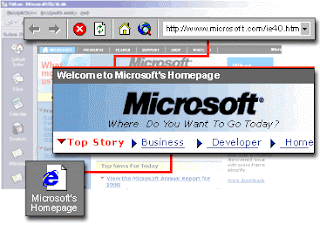

Here are some of the Internet features you can use:
View Web pages in Outlook You can view frequently used Web pages in the Outlook window by adding shortcuts to those pages to the Outlook Bar. You can also go to sites from your Favorites menu.
Web page addresses for contacts Store a Web page address for each contact so that you can quickly go to the contact's home page.
Hyperlinks in e-mail messages Type or copy a hyperlink address into the text box of a message, and Outlook automatically makes the text into a link. The recipient can click the link to go directly to a Web page or file server.
iCalendar: Internet free/busy and meeting requests Use this Internet standard to share Calendar free/busy information over the Internet, and to send and receive meeting requests and responses over the Internet.
Outlook Express newsreader Open the Outlook Express newsreader, which is part of Microsoft Internet Explorer, from Outlook and subscribe to your favorite newsgroups.
S/MIME: Internet e-mail security Send and receive signed and encrypted Internet e-mail messages.
vCard: Internet contacts format Use this Internet standard to send and receive contact information as Internet vCards.
Folder home page Associate a Web page with any personal or Microsoft Exchange Server folder.
I want to share my experience Microsoft Outlook Technical Support and Computer Support Assistance .
Sunday, April 27, 2008
How to install Help for Outlook Forms
0
comments
Labels: Computer Help, Computer Repair, Computer Support, MIcrosoft Outlook Help, Microsoft Outlook Support, Online Tech Support, Technical Support
Labels: Computer Help, Computer Repair, Computer Support, MIcrosoft Outlook Help, Microsoft Outlook Support, Online Tech Support, Technical Support
Outlook 2000 Help contains very limited information about Outlook forms, the object model, and other programming areas. Before designing Outlook forms, install Outlook Object Library Help.
- In any Outlook form, such as an e-mail message, on the Tools menu, point to Forms, and then click Design This Form.
- On the Form menu, click View Code.
- In the Script Editor, on the Help menu, click Microsoft Outlook Object Library Help.
You cannot access the Outlook Object Library Help topics from the Microsoft Office Assistant and Computer Support. Instead, click the Answer Wizard tab and type a question to find the topic you need, or use the Table of Contents on the Contents tab.
Tuesday, April 22, 2008
Problems using handheld devices with Outlook?
1 comments
Labels: Computer Help, Computer Repair, Computer Support, Online Tech Support, Technical Support
Labels: Computer Help, Computer Repair, Computer Support, Online Tech Support, Technical Support
Handheld and palm-size devices are becoming increasingly popular because they enable you to read and compose e-mail, schedule appointments, track contacts, and much more while you're on the road or away from your desktop computer. The most common problems users experience with handheld and palm-size devices and Microsoft Outlook 2000 are related to the synchronization process. Synchronization transfers information you record in the handheld or palm-size device to your desktop PC and information from your desktop PC to the device through synchronization software.
Synchronization software varies among users. You might be using the software provided with your device, or third-party software. The combination of synchronization software, device, and its operating system affects how you resolve synchronization problems. Consequently, if you have problems with information you've synchronized, first consult the documentation or support resources for your synchronization software. If you determine the problem isn't with that software, search the Microsoft Help and Computer Support Web site for information on specific types of handheld or palm-size devices or for information on specific types of synchronization software.
Subscribe to:
Posts (Atom)